Quick Answer
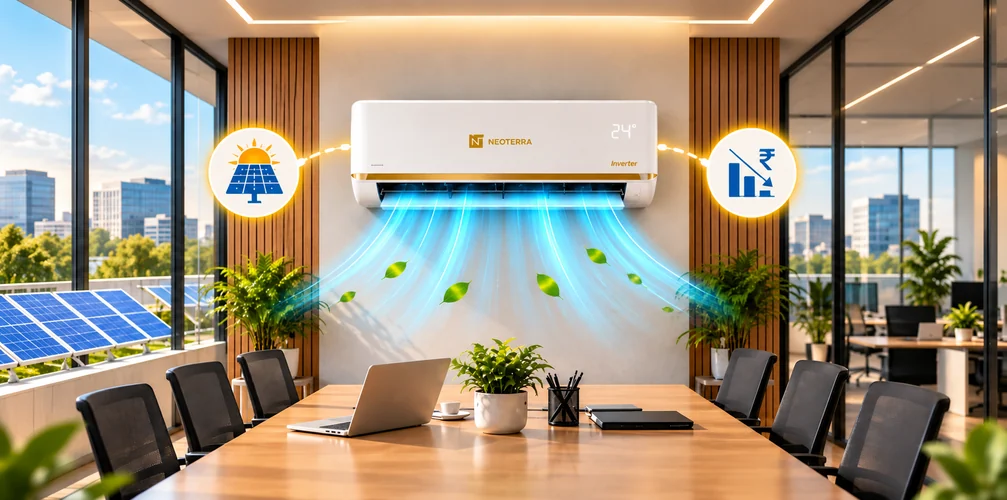
Solar AC can be a compelling option for businesses that have significant cooling requirements, particularly when air conditioners operate during daylight hours. Solar generation can offset part of the electricity otherwise purchased from the grid, potentially reducing recurring cooling costs.
Why Cooling Is a Business Expense
For a business, every electricity unit has an economic value.
Electricity powers:
- Computers
- Lighting
- Equipment
- Refrigeration
- Fans
- Air conditioners
Among these, cooling can become a significant expense in hot climates.
For a business running several ACs throughout the day, the cumulative electricity cost can be substantial.
The Daytime Advantage
This is where commercial solar cooling gets interesting.
Many businesses operate:
9 AM → 6 PM
or longer.
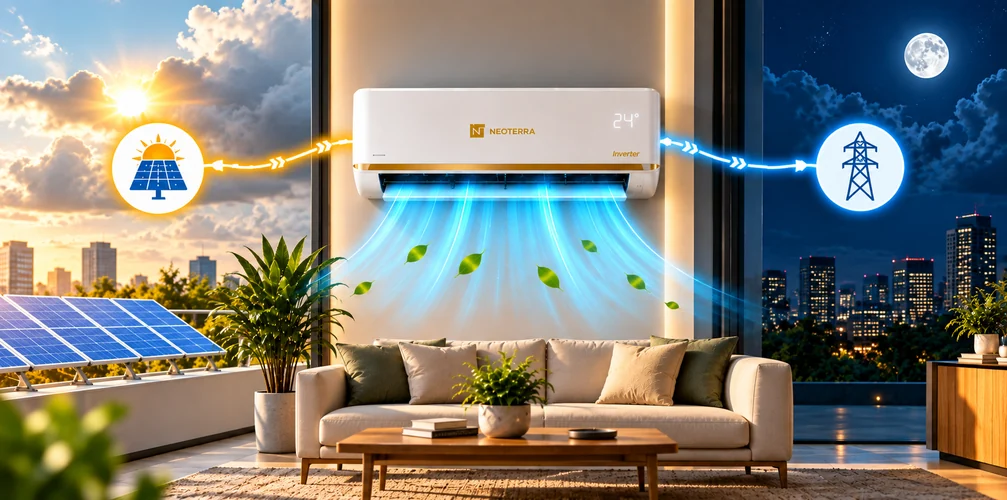
Solar generation is also available primarily during daylight.
So you get:
Business operating
AC running
Solar generating
at the same time.
This overlap can make solar-powered cooling particularly relevant for commercial users.
Solar AC for Offices
An office may have:
- Multiple cabins
- Conference rooms
- Open workspaces
- Reception areas
- Server/technical areas
As the number of cooled spaces increases, so does total cooling electricity consumption.
Solar-powered cooling can help businesses explore ways of reducing dependence on grid electricity.
Solar AC for Coaching Institutes
Coaching institutes are another interesting use case.
Classrooms can be occupied for several hours a day, particularly during afternoon sessions.
Multiple classrooms can mean multiple ACs.
That means cooling becomes an operating expense rather than an occasional household purchase.
For an institute, the relevant question becomes:
How much does classroom cooling cost every month?
Solar-powered cooling can potentially reduce part of that expense.
Solar AC for Retail Stores
Retail stores need comfortable indoor temperatures for:
- Customers
- Employees
- Product areas
And the AC may operate for the entire business day.
Because retail activity occurs primarily during daylight, there can be a natural overlap with solar generation.
Solar AC for Clinics
Clinics and healthcare-related spaces may require consistent indoor comfort.
While the exact energy requirements vary significantly by facility, solar-powered cooling can be evaluated as part of a broader building energy strategy.
Solar AC for Restaurants and Cafés
Cooling can be important in customer-facing spaces.
However, businesses should evaluate the complete electricity profile, including refrigeration, kitchen equipment and lighting.
Solar-powered cooling can form one part of the overall energy strategy.
How Businesses Should Calculate Solar AC ROI
Businesses should start with:
Monthly AC consumption
How much electricity do the ACs currently use?
Electricity tariff
What does each unit of electricity cost?
Solar contribution
How much cooling electricity can solar potentially offset?
Annual savings
What is the estimated yearly reduction?
Payback
How long will it take to recover the additional investment?
This gives the business a much clearer picture than simply comparing product prices.
Why Neoterra for Commercial Cooling?
Neoterra’s approach to solar-powered cooling is particularly relevant to organizations looking at:
Cooling cost + energy consumption + sustainability
rather than simply buying another AC.
Its indoor air-quality proposition, including PM1-focused filtration capabilities, can also be relevant in spaces where people spend several hours indoors.
Is Solar AC Suitable for Every Business?
No.
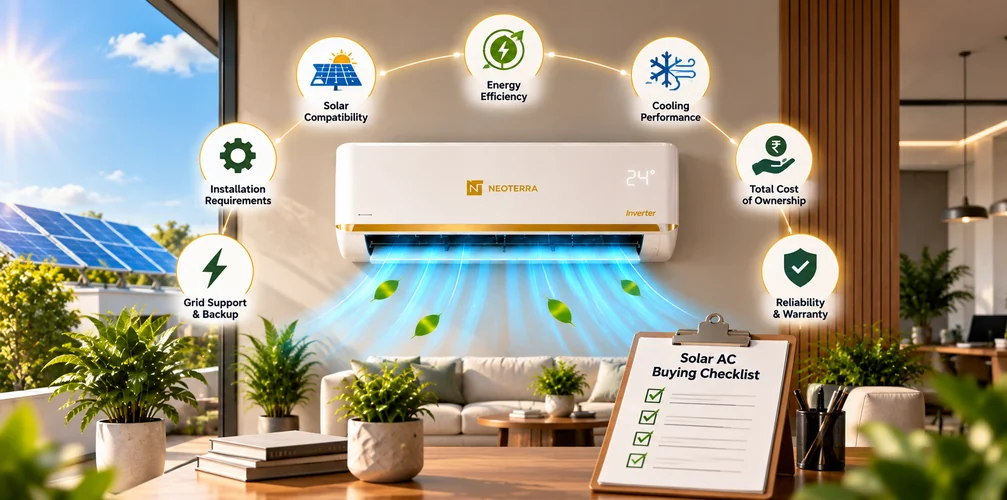
Businesses should consider:
- Operating hours
- AC usage
- Rooftop availability
- Solar potential
- Electricity tariff
- Building ownership
- Installation requirements
- Expected period of occupancy
A proper site assessment is important.
FAQs
Is solar AC good for offices?
It can be particularly relevant because offices often operate during daylight hours when solar generation is available.
Can coaching institutes use solar AC?
Yes. Coaching institutes with multiple air-conditioned classrooms can evaluate solar cooling as a way to potentially reduce recurring electricity costs.
Can shops use solar AC?
Yes. Shops operating during daylight hours may have a useful overlap between solar generation and cooling demand.
Can businesses save money with solar AC?
Potentially. Savings depend on electricity consumption, solar generation, tariffs and system configuration.
Final Takeaway
For businesses, AC isn’t just a comfort appliance.
It’s an operating expense.
And when that expense repeats every month, finding a smarter way to power cooling can have a meaningful impact on long-term economics.
Solar-powered cooling gives businesses another option:
Use the sun to help power the cooling your business already needs.
Explore Neoterra Solar AC for commercial cooling.