Quick Answer
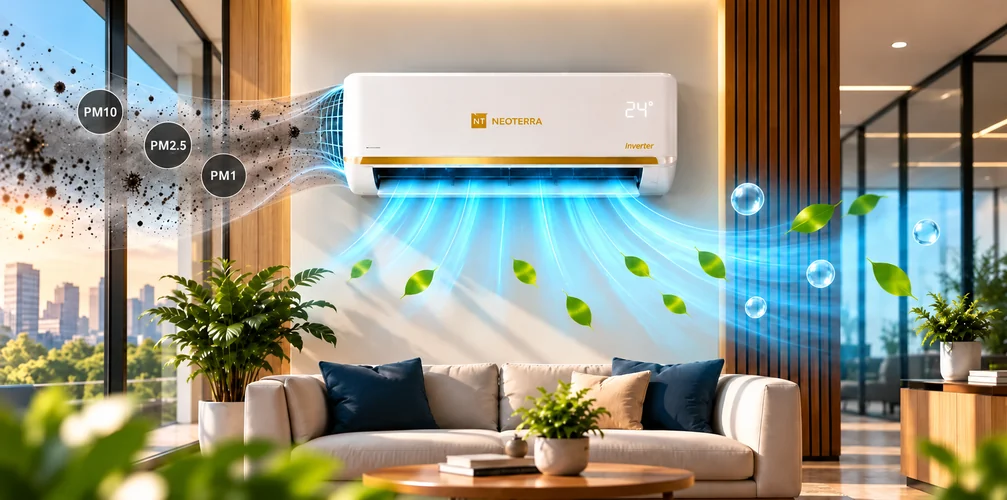
Indoor air quality is influenced by particles and pollutants that can enter or be generated inside a building. PM2.5 refers to particulate matter with an aerodynamic diameter of 2.5 micrometres or smaller, while PM1 refers to particles of 1 micrometre or smaller.
Air-conditioning systems can play a role in indoor air management when they incorporate appropriate filtration, although filtration performance depends on the filter technology, design and operating conditions.
What Is PM?
PM stands for particulate matter.
It describes a mixture of extremely small solid particles and liquid droplets suspended in the air.
Different PM categories refer broadly to particle size.
PM10
Particles up to approximately 10 micrometres.
PM2.5
Particles up to approximately 2.5 micrometres.
PM1
Particles up to approximately 1 micrometre.
The smaller the particle, the more challenging it can be to capture using basic filtration systems.
Why Does PM1 Matter?
PM1 represents a particularly small fraction of airborne particulate matter.
Because these particles are so small, filtration technology becomes important when designing systems intended to reduce their presence in indoor air.
However, consumers should distinguish between:
filtering capability
and
complete air purification.
A filter’s effectiveness depends on its design, efficiency, airflow and operating conditions.
Can an AC Improve Indoor Air Quality?
An AC’s primary job is cooling.
However, the filtration system within an AC can influence the air passing through the unit.
Depending on the filtration technology, an AC can help reduce certain airborne particles.
This is why modern cooling systems are increasingly being evaluated not only for:
“How cold can it make the room?”
but also:
“What happens to the air as it passes through the system?”
Why Basic AC Filters Aren’t Always Enough
Many conventional AC filters are primarily designed to protect the equipment and capture larger dust particles.
That doesn’t automatically mean they provide high-efficiency filtration for very fine particulate matter.
Consumers interested in air quality should therefore look for actual filtration specifications rather than assuming that every AC filter performs the same way.
What Makes Neoterra Different?
Neoterra looks at cooling as more than temperature control.
Its product proposition combines:
Cooling
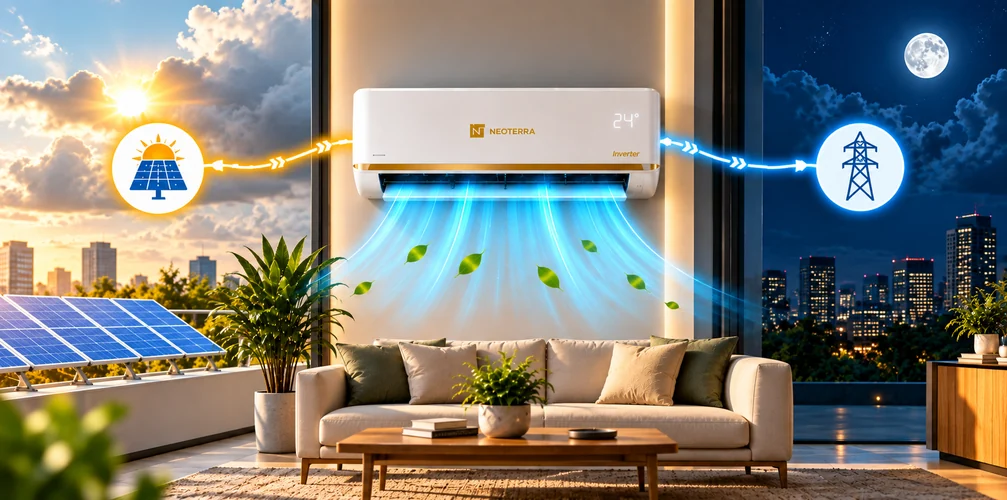
Solar-powered energy use
Energy savings
Indoor air-quality considerations
Neoterra AC includes PM1-focused filtration capabilities, bringing greater attention to fine particulate matter as part of the indoor environment.
For technical evaluation, buyers should refer to the specific filter specification and test methodology provided for the product.
Solar Cooling + Air Quality
The combination is interesting because it addresses two different concerns.
Energy
How much electricity does cooling require?
Environment
What kind of air are people breathing indoors?
Neoterra’s broader product philosophy connects these questions.
The goal is not simply to make the room cooler.
It is to make everyday cooling more thoughtful.
Does an AC Replace an Air Purifier?
Not necessarily.
An AC with filtration isn’t automatically equivalent to a dedicated air purifier.
Performance depends on:
- Filter efficiency
- Airflow
- Room size
- Filter condition
- Operating hours
- Pollutant concentration
- System design
Consumers should compare the actual specifications of both products.
How Can You Improve Indoor Air Quality?
Filtration is only one part of the solution.
Other useful measures include:
- Regular filter cleaning
- Adequate ventilation where appropriate
- Reducing indoor pollution sources
- Controlling dust
- Maintaining AC systems
- Monitoring indoor air quality where relevant
- Using appropriately specified filtration systems
FAQs
What is PM1?
PM1 refers broadly to particulate matter with an aerodynamic diameter of 1 micrometre or smaller.
Is PM1 smaller than PM2.5?
Yes. PM1 is a subset of smaller particulate matter within the broader PM2.5 category.
Can an AC filter PM1?
Some AC filtration systems are designed to capture very fine particles, including PM1. Performance depends on the filter specification and system design.
Is a PM1 filter the same as an air purifier?
No. A filtration feature in an AC and a dedicated air purifier can have different designs, airflow characteristics and performance.
Why does indoor air quality matter?
People spend substantial time indoors, so reducing unwanted airborne particles can be an important part of maintaining a better indoor environment.
Final Takeaway
The modern AC is evolving from a simple cooling appliance into a broader indoor-environment technology.
For Neoterra, that means thinking about both sides of the experience:
The energy used to cool the room
and
the air circulating inside it.
Solar-powered cooling addresses the first.
Thoughtful filtration addresses the second.
Together, they represent a more complete vision of modern cooling.
Neoterra — smarter cooling for a changing world.