Quick Answer: Is Solar AC Worth the Cost?
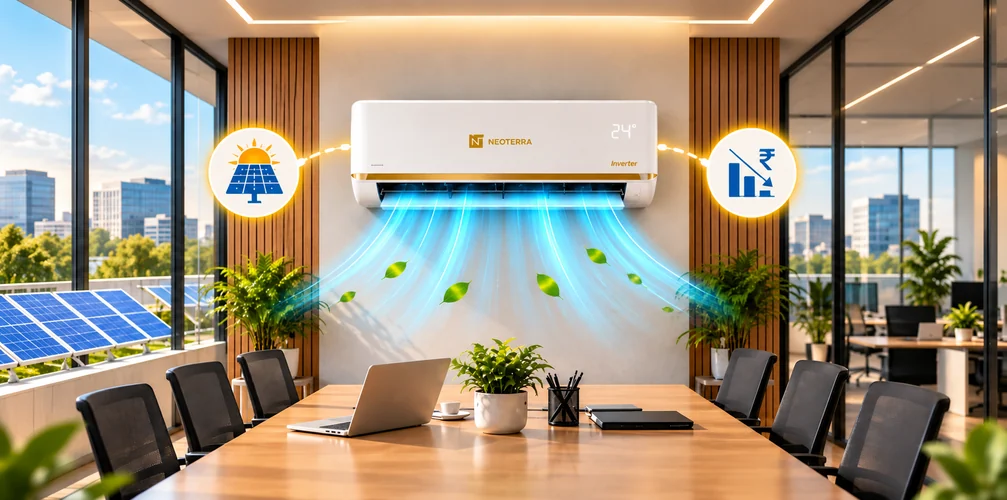
A solar AC can be worth the higher upfront investment when its long-term reduction in grid electricity costs is large enough to offset the additional initial cost.
The strongest financial case generally occurs when the AC is used frequently, electricity tariffs are relatively high and sufficient solar energy is available.
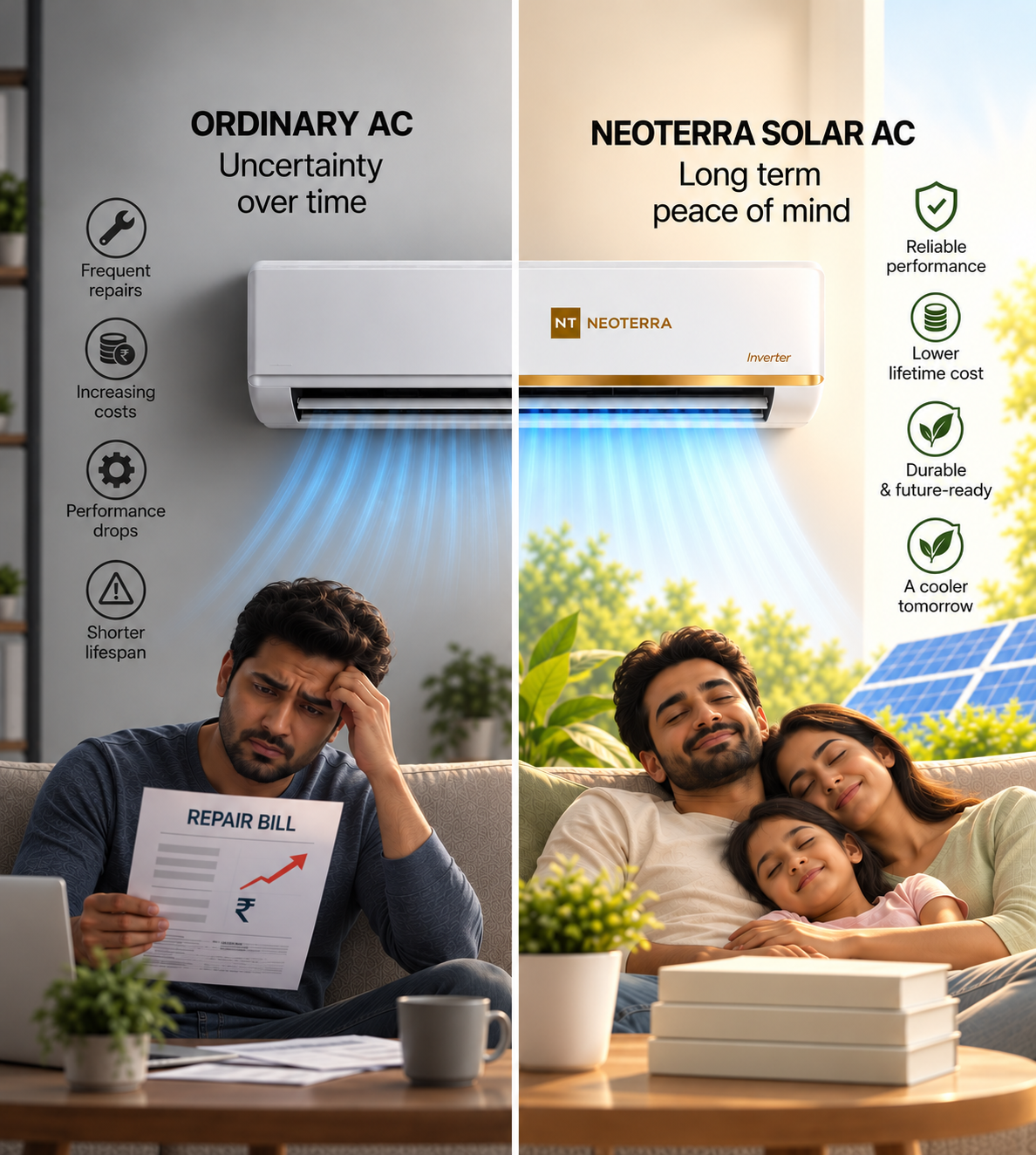
The right way to evaluate a solar AC is therefore total cost of ownership, not purchase price alone.
Why Solar AC Can Cost More Initially
A conventional AC primarily requires the air-conditioning equipment and standard installation.
A solar AC solution may involve additional solar-related equipment or integration.
That can increase upfront expenditure.
But this additional investment has a purpose:
to reduce recurring energy expenditure.
Think of it like buying an energy-producing asset alongside a cooling appliance rather than looking at the AC as a standalone purchase.
The Correct Way to Compare Solar AC Cost
Don’t compare:
Solar AC price vs normal AC price
Compare:
5–10 year total cost of ownership
A simple framework is:
Conventional AC
Purchase + installation + electricity + maintenance
Solar AC
Purchase + solar/installation + electricity after solar contribution + maintenance
The winner isn’t necessarily the system with the lower purchase price.
It is the system with the better economics over the period you actually use it.
What Is the Payback Period?
The payback period estimates how long it takes for energy savings to recover the additional investment.
A simplified formula is:
Payback Period = Additional Initial Investment ÷ Annual Electricity Savings
Illustrative example
Suppose:
- Additional solar investment = ₹100,000
- Annual electricity savings = ₹20,000
Then:
₹100,000 ÷ ₹20,000 = 5 years
This is only an example.
Actual payback depends on the customer’s electricity tariff, AC usage, solar generation, installation cost and system performance.
What Makes Solar AC Payback Faster?
Higher AC usage
If an AC runs for many hours every day, there is more electricity consumption that solar energy can potentially offset.
Higher electricity tariffs
Every unit of grid electricity displaced becomes more valuable when electricity costs more.
Strong solar generation
More useful solar electricity can increase the amount of grid consumption avoided.
Daytime usage
If the AC operates while solar generation is available, direct solar utilization can be particularly useful.
Longer ownership
A system that takes several years to recover its additional investment becomes more attractive when you plan to use it for many years.
What Can Make Payback Slower?
The reverse is also true.
Payback can take longer when:
- AC usage is low
- Solar generation is limited
- The installation has significant shading
- Electricity tariffs are low
- Initial system costs are high
- The property is used only occasionally
This is why Neoterra should encourage buyers to evaluate their own usage rather than presenting a one-size-fits-all ROI claim.
Solar AC Price: What Should You Actually Look At?
When comparing solar AC prices, ask what is included.
A quote may include:
- AC unit
- Solar panels
- Solar controller/inverter components
- Mounting
- Wiring
- Installation
- Protection equipment
- Other accessories
Always compare complete installed system cost, not just the headline AC price.
Should I Buy Solar AC If I Already Have Rooftop Solar?
This can be an especially interesting question.
If a property already has solar generation, an AC can potentially consume some of that renewable electricity.
However, whether a dedicated solar AC solution is beneficial depends on:
- Existing solar capacity
- Current electricity consumption
- Rooftop generation
- Net-metering arrangement where applicable
- AC usage
- Existing inverter architecture
The economics should be evaluated based on the complete energy setup.
Is Solar AC a Good Investment for Businesses?
It can be.
Businesses often have two characteristics that can strengthen the case:
High electricity consumption
and
Daytime operation
Imagine an office or coaching institute where several ACs operate throughout the afternoon.
The business is consuming electricity precisely when sunlight is available.
That creates a natural opportunity for solar-powered cooling.
Why Neoterra?
Neoterra’s approach is based on a simple proposition:
Cooling should be evaluated as a long-term energy expense, not just as a one-time appliance purchase.
Neoterra Solar AC combines cooling with solar energy to help users reduce their dependence on grid electricity.
For customers who use AC regularly, this can shift the conversation from:
“How much does this AC cost?”
to:
“How much will this AC cost me to own?”
That is a much more useful financial question.
A Simple Solar AC ROI Checklist
Before purchasing, calculate:
☐ AC usage hours per day
☐ Number of ACs
☐ Electricity tariff
☐ AC electricity consumption
☐ Available solar generation
☐ Solar installation cost
☐ Total system cost
☐ Expected ownership period
☐ Estimated annual electricity savings
☐ Simple payback period
FAQs
How much does a solar AC cost?
The total cost depends on AC capacity, solar capacity, system configuration, installation and other components. A complete installed-system quote is more useful than the AC-only price.
Is solar AC more expensive than a normal AC?
The upfront investment can be higher because solar-related equipment may be included, but operating costs can potentially be lower.
How long does solar AC take to pay for itself?
The payback period varies. It depends primarily on additional investment and annual electricity savings.
Is solar AC worth buying in India?
It can be particularly attractive for high-usage consumers with suitable solar potential and meaningful electricity costs.
Does solar AC save money in the long term?
It can. The financial benefit comes from reducing the amount of grid electricity purchased for cooling.
Final Verdict
The cheapest AC to buy isn’t necessarily the cheapest AC to own.
If you’re comparing cooling systems for the next few years, the better question is:
“What will my total cooling cost be over its lifetime?”
For households and businesses with substantial AC usage, solar-powered cooling can make that equation considerably more interesting.
Explore Neoterra Solar AC and calculate the economics for your cooling needs.